Back to Home Page

Electric Toasters Made in the U.S.A.
during the Roaring Twenties


Home. . . 1920s. . . 1930s. . . 1940s & later. . . Non electric. . . 220 Volt. . .
Classic Appliances . . . Waffle Irons. . . Popcorn Poppers. . . Cookers Fryers. . .
Working but. . . Decorator Special . . . Toast Racks. . . "toasterNotes" Cards. . .
Replacement Cords. . . FAQ. . . Links. . . Recipes . . . Repair Service. . .

Spring Loaded Doors

Very Compact 1928 Toaster

I get asked for the smallest possible toaster by people with micro kitchens, and this one is a very good choice. The footprint on this one is only 4.25 by 8.25 inches, standing seven inches tall.

The doors are spring loaded with good, strong springs, so you can load in bread sliced very thin to very thick, or even toast a bagel half. It is very versatile for hand-sliced breads of varying thickness.

The previous owner(s) of this toaster treated it very well. Many years ago, the heating element was repaired and done properly. The plating is still in good shape, even on the inside of both doors. It comes with a detachable cord set which plugs into the side. Because the spades are flat, only a vintage plug will fit.

Very Compact 1928 Toaster
106-115 Volts 600 Watts
Manning-Bowman & Co. Meriden, Conn. U.S.A.

$120

Purchase Information


The Star-rite Reversible Toaster

When this toaster was on the market in 1924, the film Greed directed by Eric von Stroheim was on the big screen, starring Zasu Pitts, who might have been driving the new Studebaker.

The Fitzgerald Manufacturing Co. in Torrington, Connecticut made this sparkling Super Toaster. That company was a purveyor of Electrical Necessities among other things.

This model earned its name by virtue of its cages which are mounted on a spring loaded arms that allows the slice to be turned to the other side by the twist of the knob on top. It plugs in beneath one door.

These are fairly common and were a very good value for five dollars versus eight or twelve for higher priced toasters of the time, and many of them survive until today; however, the cages on most of them are pretty well rusted, if not completely deteriorated.

This one is in very good condition, retaining most of the nickel plating on the cages. There is a small chip on the top of one knob. It comes with a vintage deluxe switched cord set. These were popular as gifts.

Star-rite Reversible Toaster

$245

Purchase Information
Advertised in Good Housekeeping in 1923


Patent granted in September of 1912.

Pelouze Vertical Toaster circa 1912

This is the least common of any toaster for sale here at Toaster Central. Because it is so early, it was still a new-fangled thing.

According to the Charles P. Fisher book on toasters "Edward Schwartz received a design patent on the spidery cabriole-legged percher, which was made by Pelouze Mfg. of Chicago." I think it is interesting that two dates are shown on the badge, for both the patent application date and also the date the patent was granted.

It's a striking piece, even in profile.

And, yes, it still works. It's in beautiful condition with minor repair to the mica plates that is not conspicuous, and otherwise all original. But, this is really a show piece and I'd not recommend using it frequently. Great gift for a patent lawyer, inventor, or someone who already has everything and doesn't need a gift from Sharper Image.

Pelouze Vertical Toaster circa 1912
110 Volta 500 Watts
Pelouze Manufacturing Co. Chicago

$2250

Purchase Information


1920 Thermax Toaster

According to Charles Fisher in Early American Electric Toasters, the frame of this toaster was originally designed by Alonzo Warner, then modified by and patented by James Lamb at Landers, Frary & Clark. It continued in production for at least fifteen years. Later models had different doors, and a slightly different top.

This model was made 1919 to 1923, for those early adopters of technology who had their homes wired for electricity. Many people still used gas light and kerosene lamps. The doors are spring loaded and will accept thick material such as a bagel half or hefty crumpet. The design features the economical three panel design for the heating element.

1920 Thermax Toaster
Landers, Frary & Clark New Britain, Conn.

$285

Purchase Information
Made between 1919 and 1923


The Layfayette pattern from Landers, Frary & Clark.

Toast in a Drawer from the mid-1920s

This toaster came out in the 1920s, right around the time that the famed Toastmaster Automatic Pop-up Toaster hit the market in 1926 and was a huge success. This being America, competition for a share of the market was fierce among manufacturers of small electric appliances. An automatic toaster was a new-fangled thing. The shape is architectural and the decoration is in the Lafayette pattern . Every detail is finished and decorated including the fasteners for the feet decorated with rosettes. This toaster was from one of a whole line of small appliances.

To make toast, first you plug in the cord and the current starts immediately to heating panels; you have to let it warm up for a minute or two.

The controls are located on the narrow side. At the bottom is the drawer handle, then next above is a stop lever which latches into a sawtooth slot to set the degree of doneness. Place the bread in the holder, close the drawer, then push down the upper lever to start the timing clock. It whirs furiously and then a bit erratically while the top lever slowly rises to the starting postion and when it does, it trips a lever to release the drawer which is spring loaded and pops out with the finished toast. The drawer is removable for easy cleaning.

Mind you, the drawer popped open, but the current is still on. It is essentially an oven style toaster with a timer to release the drawer. There is no internal mechanism to turn off the current which would probably have violated the patents held by Toastmaster. So, the toaster comes with a deluxe cord set with a switched plug for ease of use.

This is a good choice for a special gift for an antique collector, patent lawyer, designer, artist, etc. and while it does work, it is not recommended for anything but occasional use. By the way, you can demonstrate the mechanism without plugging in the cord.

Toast in a Drawer
Universal The Brand Name Known In Every Home
New Britain Conn. U.S.A.

$225

Purchase Information


Toastmaster model Automatic Pop-up Toaster

Charles Perkins Strite was the guy in Stillwater, Minnesota who paired a clockworks timer and set of carbon contacts together with heating elements to cook both sides of a slice at once AUTOMATICALLY, without turning or burning as with the manual, fold-down-door models It became a popular product when it hit the home market in 1926 as The Toastmaster, deemed one of the greatest all-time inventions according to American Heritage and others, millions of 'em, people who adore their old Toastmaster.

This single slice unit has two control levers: one pushes down to wind a spring that operates the clockwork mechanism, and the other lever pushes down to lower the bread and starts the current. In addition, there is a spring-loaded stop below the right lever to set the shade of darkness, and a small lever in between the two big levers to pop the toast up before the end of the cycle.

Produced from June 1926 to August 1930
by Waters-Genter Co. Minneapolis, U.S.A. 110 Volts 600 Watts

SOLD

Purchase Information
Toastmaster model 1A1, the first automatic pop-up toaster


Toast rack mounted on top of the toaster.

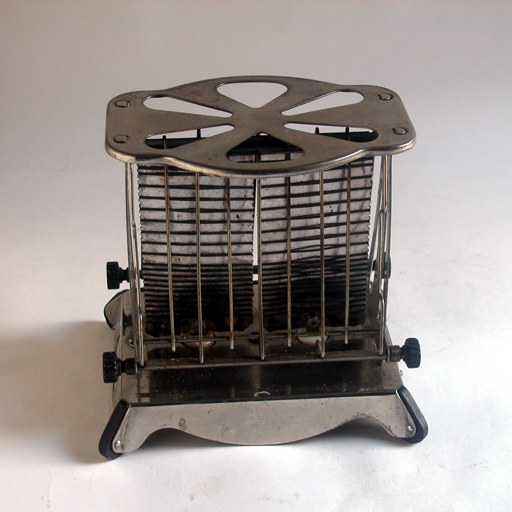
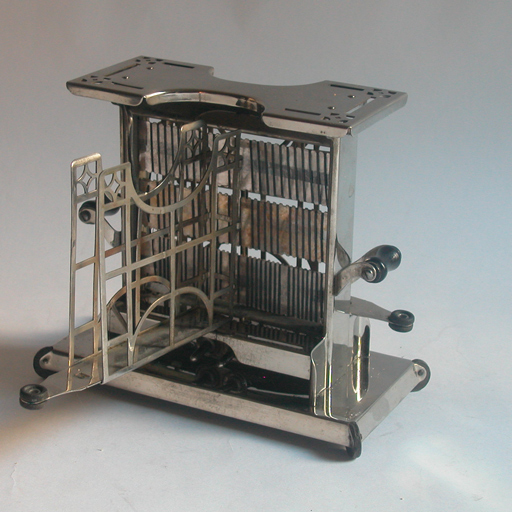
Early Toaster with Rack Mounted On Top

Electric toasters had been around for less than a generation when this electric toaster was made in New Britain, Connecticut, by a company known for its high quality cutlery, hotel and hospital ware, and really beautiful early electric appliances.

The detachable cord plugs into the center of the base. The two doors are spring-loaded to clamp the bread against the guide wires and efficiently close to the heat to toast one side of each slice. Then you have to open the door, flip the slice to the other side and finish the toasting. This toaster has the deluxe feature of a built-in toast rack which keeps the finished toast warm while you are making more.

This toaster is in good condition with minor signs of wear. It comes with a deluxe switched cord set. This is one of the few toasters that will handle half a bagel, assuming you want only the cut side toasted.

Universal The Brand Name Known In Every Home
New Britain Conn. U.S.A.

$265

Purchase Information


Red Torrid Toaster

Made in Hartford, Connecticut, this toaster has been used, abused, and seriously neglected, but still makes toast! The red fittings are unusual, and the doors swing from sideto side. The toast shows the pattern from the door.

The condition of the base is especially poor where most of the nickel plating has deteriorated, and the sides are pitted. It comes with a detachable cord set.

Torrid Toaster in Red
Hartford, Conn.

$125

Purchase Information
Red Hot Toast


Westinghouse Turnover Toaster Westinghouse E. & M. Co.  East Pittsburgh, PA.

Westinghouse Turnover Toaster

The earlier version of this toaster, with a ceramic core rather than mica, was advertised for Christmas in 1916, but this toaster dates a few years later when Westinghouse was still in East Pittsburgh, before the move to Mansfield, Ohio. This model has a permanently attached cord which I've replaced and fitted with a bakelite plug.

Turnover Toaster Style N0.284032A
Westinghouse Elec..& Mfg.. Co.
East Pittsburgh, PA. U.S.A.
Volts 100/120 Watts-550.
LMP diamond
Patented 7-28-14 9-25-14
the WEP inside a double circle

$185

Purchase Information


The First Swinger

This is a fairly fancy toaster called the Electroweld with colored handles, swinging doors and a rather odd on/off switch that looks like it should be a lamp socket. This one is in good condition and is complete except for what must have been colored fiber feet.

This toaster is interesting because it is based on the first patented design for a toaster with with swinging baskets. The patent was granted in November 1920. The original had just wire handles and a heavy cast-lead weight in the base, but this later version has turned wood handles.

Pat. Nov. 16, 1920 is the only marking on the bottom.

$310

Purchase Information
Circa 1922-1925 made in Linn Mass.


Sweeheart' toaster from 1929 made in New Britain, Connecticut

Universal Push Button Toaster

Very ornate from the late 1920s with push buttons to flip the toast baskets to the other side. It has a nickel-plated body and the drop handles, push buttons, and feet are ivory colored material. It is decorated everywhere. First production circa 1928-1929.

Universal --"The Brand Name Known In Every Home"
Landers, Frary & Clark, New Britain, Conn. U.S.A.
108-116 Volts, 525 Watts

$900

Purchase Information


The "E-Z TURN" Toaster

I believe this toaster is from the late 1920s, but with a rather art nouveau motif which was popular several decades earlier. The toaster sports nickel plating and turned up feet with nearly concealed fiber feet, and a nice name badge. mounted on the base. There is a mechanism to flip the slice to toast the other side when the door is opened and closed, hence the name. It is in good condition and comes with a detachable cord set.

I've seen this same toaster called the BEE-VAC from the Birtman Electric Company in Chicago which sold vacuum cleaners. It is well constructed of sturdy materials into a very pleasing design.

$125

Purchase Information
Also known as a BEE-VAC


Thrill your family in the morning with the Estate Electric Toaster.

The Estate Electric Toaster

Advertised in 1924, this early electric four-slice toaster for the home has four cages that simulaneously rotate 270 degrees in order to toast first one side and then the other side of all four slices. It is a real crowd-pleaser.


This one is in quite good condition, retaining its nickel plating which is usually quite deteriorated, with very minor corrosion. Its original cord is still in good shape and should be treated as fragile, It sports a nice badge on the base.

The Estate Stove Company, Hamilton Ohio,
Patents Pending. 110 Volts, 5.5 Amps

$265

Purchase Information

Toastoy - miniature working electric toaster

This child's toy is a miniature working scale model of an electric toaster. It sold in the 1920s for one dollar, or for a quarter more west of Denver. Nickel plating is in rough shape, sold as is. This actually still works.

Produced by the Excel Electric Company at Walnut and 20th Streets in Muncie, Indiana.

Excel Electric Company, Muncie, Indiana

$145

Purchase Information
Advertisement for the Excel Toastoy circa 1929 The fast way to learn about 'hot'.


Two slices in a drawer.

The Heatmaster

This is a toaster for the design purist, because it ain't the world's best toaster. But, it sure is stylish, very architectural for a toaster. It is not automatic at all. The heat is on as long as it is plugged in. Two slices get toasted on both sides (more or less). The bread is put in the drawer standing up, then the drawer is closed.

This is more of a show piece than a toaster suitable for frequent use. It is in excellent condition except for a tiny dimple in one side. It comes with a detachable cord set. Perhaps more suitable for display in an architect's office hiding valuables

Heatmaster sold at Sears and Roebuck

$45

Purchase Information

The Original Electric Toaster

General Electric introduced an electric toaster in 1909 with a white porcelain base, then made several modification within the first few years, and introduced this floral model with platinum banding well before World War I. One just leans a piece of bread on either side.

This one is in excellent condition and still works, but is suitable for very occasional use. It comes with a detachable cord set.

After a hundred years of products in American homes, General Electric is putting the appliance division on the block. Who will bid? What are the chances it will remain under American management? This toaster marks the opening of a proud business, and perhaps will see its end.

First American Electric Toaster circa 1911
General Electric

SOLD

Purchase Information
First American Electric Toaster.


Two slices in a drawer.

Gold Seal Toaster

From the 1920s, the Gold Seal Electric Co. in Cleveland, Ohio made this small but efficient little toaster. Each side has a cage mounted at the end of an arm which swings away from the body to the cage to pivot to the opposite side of the slice.

This one is unusual because it has a name badge located on the base -- most I've seen don't have one. It carries the company's trademarked slogan of three words: Quality Service Value (excuse my crumbs).

It shows its age, mostly by way of deterioration of the nickel plating and rusty cages. Still, it will turn out toast in a jiffy. It comes with a detachable cord set.

Gold Seal Toaster
Quality Service Value
Cleveland, Ohio

Shipping weight 4 Lbs.

$145

Purchase Information


Early Toaster from Detroit

According to the book by Charles P. Fisher Early American Electric Toasters, in March, 1905, George Schneider invents a practical if complicated, enclosed toaster specifying "suitable resistance wire", probably referring to the alloy invented by Albert Marsh. The patent is assigned to American Electrical Heater Co.

This one is very old, very rusty and very scary looking. It comes with its a cord set and with signed plug in remarkably good shape, I haven't plugged it in and I haven't taken it apart.

It makes a good gift for a toaster collector, but certainly not for making toast.

The base has very nicely applied feet on each corner. The frame looks to have a sliding key construction where it meets the base. My friend Dan has taken one of these apart and reports that the core is made up of a mica plate wound with very broad ribbon resistance wire, enclosed in more mica, and then enclosed in sheet metal secured with two rivets.

A later model was advertised in 1912; note the broad top that would hold a slice of toast. And, I've owned a couple of pieces from this same company in Detroit.

American Electrical Heater Co.
Detroit U.S.A.

$95

Purchase Information
The scariest toaster I've seen.


Two slices in a drawer.

The Absolute Minimalist Toaster

From the 1920s, this one looks like the most minimal toaster ever. In profile, it looks architectural. It is called the Steelcraft and came in different colors, and is not very commonly found. It has a spring-loaded door hinged at the bottom on each side.

We have left the original paint in spite of the rust. While this one still works, we don't recommend using it unless you intend to inflict bodily harm.

This toaster is suitable as a gift to a toaster collector, or someone who has absolutely everything, or perhaps a patent lawyer, inventor, or historian.


Minimalist Toaster
Steelcraft in yellow

Shipping weight 4 Lbs.

$185

Purchase Information


Home. . . 1920s. . . 1930s. . . 1940s & later. . . Non electric. . . 220 Volt. . .
Classic Appliances . . . Waffle Irons. . . Popcorn Poppers. . . Cookers Fryers. . .
Working but. . . Decorator Special . . . Toast Racks. . . "toasterNotes" Cards. . .
Replacement Cords. . . FAQ. . . Links. . . Recipes . . . Repair Service. . .
Contents © 1999-2008 MichaelSheafe